Designing For Change: Innovation, Biophilia and Transformation
Alex Kravetz
Principal and Creative Director of Alex Kravetz Design
Your work is renowned for blending timeless elegance with contemporary innovation. How do you incorporate emerging design technologies into your creative process while maintaining the refined, sophisticated aesthetic that defines Alex Kravetz Design?
What I see changing practically every day with the advance of the new technologies is our workflow as well as efficiency. The research is becoming incredibly diverse and it is now much faster to obtain the quintessential information you need for the projects concept. This can be a historical context or indeed a collection of visual touchpoints. And once combined the data creates an incredibly rich roadmap for the projects creative process. Our biggest office toy is the Virtual Reality – the ability to see the entire space in 360 degrees allows not only see the space as it develops but also experiment with many aspects of the design previously impossible to do. Despite all of the above your own creativity and direction expressed via a hand drawn sketch still wins every day.
With a portfolio spanning grand historic hotels and modern luxury spaces, how do you navigate the balance between honouring traditional design elements and integrating modern innovations to create interiors that feel both enduring and forward-thinking?
I always think back to the great traditions of classical architecture – proportions, symmetry, alignment and precision. Our brain functions in a way that it always picks up the imperfections of the spaces and therefore unconsciously you will not feel comfortable or at ease in the space that is the opposite to these principles. This goes much further if the building is “aggressive” or simply speaking illogical or deconstructive in its way it encompasses a human soul. Creation of spaces which embrace the rules of comfort and order ensure that we stay on the timeless path to the ultimate destination – soul wellness. Lighting plays a huge role in this with the daylight and correct colour temperature providing a variety of moods.
Retrofitting historic spaces presents a unique challenge; modernising for today’s luxury standards while respecting the building’s original character. How do you approach this balance to ensure a seamless, respectful transformation?
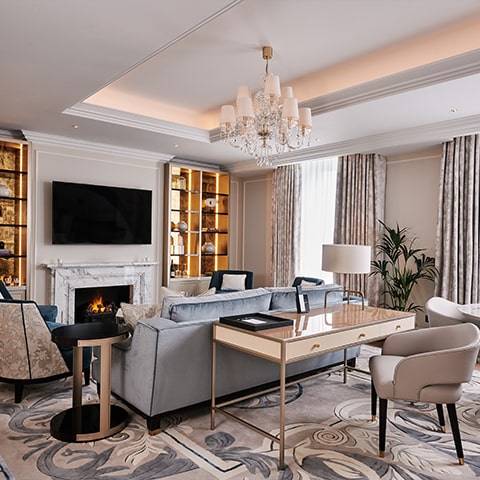
First of all, a huge amount of research goes into any historical transformation (or restoration) project. As all spaces go, they inevitably live through many transformations during their life with new designs introduced over the years. The older the building the richer its history and most probably more times it was shaped by events totally unpredictable. For example, many Hotels would have been converted into hospitals during the war or offices afterwards with stately homes becoming schools or military quarters. All of these events will have an impact of how you approach the project and where the new layer of life needs to be introduced in order for the spaces to function logically and with service perfection in mind. We would always start with the masterplan to see how the “Front of House” interacts with the “Back of House” with all the staff movements between spaces to service them, MEP (Minimum Energy Performance) interventions, fire escape routes etc. In many cases the buildings will be listed (same applies to continental Europe) and the research will be most invaluable knowledge tool in the way you can present this to the relevant authorities. But the guiding factor in absolutely everything is the actual respect for the DNA of the building.
Sustainability has become an essential pillar of modern design. What strategies do you prioritise to integrate environmental responsibility into high-end interiors without compromising on the sense of luxury and comfort?
I see sustainability in the light of longevity from every point of view. Every finish and every item of furnishings has to have a timeless approach – how natural is it and what makes it worth its value in the future. Will it retain its relevance through the constant carousel of colour and styling trends? Beautiful marble will always outlast a man made alternative in terms of its value and looks and it is the most natural material always readily available. Staying local and ensuring that local businesses and people directly benefit from employment, preservation of the artisan skills and ultimately the environment.
Biophilic design is evolving from a visual trend to a core principle for enhancing well-being and emotional engagement. How do you envision the role of natural elements within luxury interiors, and what guides your approach to merging nature with refined, high-end design?
Biophilic designs have been with us forever – just think Winter Gardens. However, as our living environments become more big cities oriented the desire to see nature is becoming more paramount. Nature has always had a positive impact on human well-being and using plants automatically requires natural light and ventilation. Maximising the impact of natural light with full height windows, living walls integration of water features creates a sense of tranquillity and rejuvenation. It is a very positive impact which further adds to my principle of the “soul wellness”.
In one of your latest projects, you explored the interplay between innovation and biophilic design. How did you weave natural elements into the space to create an environment that fosters both tranquillity and modern functionality?
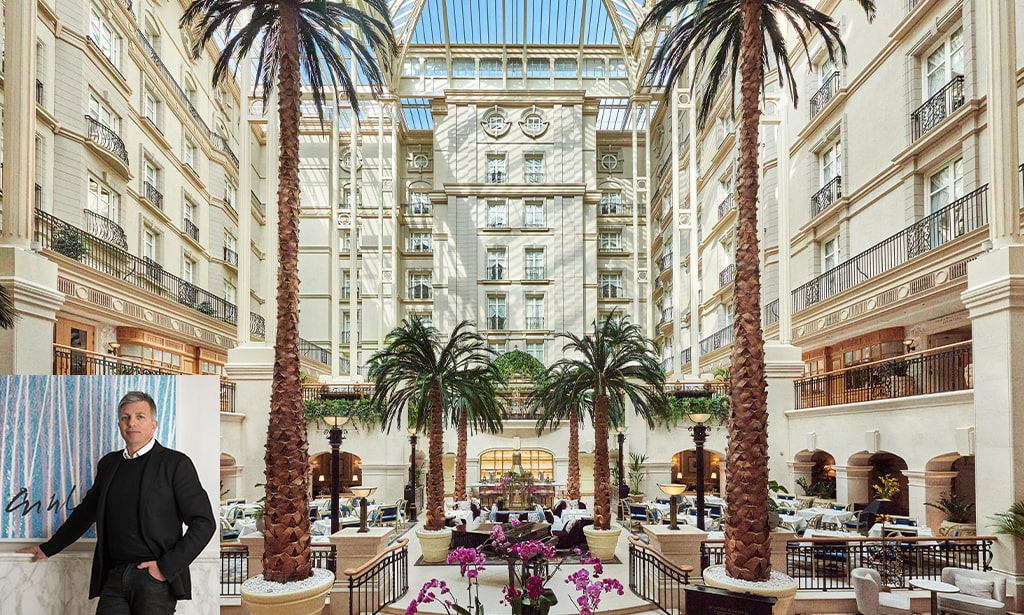
It is a hotel space that has undergone several layers of transformation including its core functionality by creating a brand-new food and beverage outlet and making the space a very active as well as profitable. This involved a change in operation and thus a necessity to create the environment that is more welcoming and comfortable for the guests throughout the day. Being the second tallest atrium space in Europe at 35 meters it was a very challenging task to create a space that functions seamlessly throughout the day with the change of light and weather. Every shade of colour variation during these conditions ensuring that our choice still makes an impact was time consuming but it paid off. We have introduced masses of new plants to ground everything at low level and introduced Bluetooth controlled lighting for the evening scenes to make sure all features were highlighted. As a result, the space looks very different during the course of the day where you never get tired of the same look.