
A biophilic approach
to work-life balance
BY NADÈGE ELYSE MUSTAFA
11 May 2026
A biophilic approach to work life balance is a trend best unearthed. As the contemporary office evolves, light, air and landscape are set to mirror nature’s natural terrain, with design readily becoming a statement in itself. Re-working the nine to five, designers and architects Perkins & Will borrow the language of retreats and wellness, over the sharp edge of corporate.
A verdant vision, Five Bank Street, located in corporate’s beating heart, Canary Wharf, London, sought to co-create and deliver a best-in-class working environment for the European Bank for Reconstruction and Development’s new headquarters, all whilst cultivating a mindful ecosystem. A truly synergetic project has been brought to life, thriving and rich in sustainability, diversity, inclusion and more. The new workspace is functional, flexible, and encourages full mobility to support business needs in a fair and transparent manner, reflecting the Bank’s cultural diaspora. With an eco-conscious approach a key driver, the fit-out was tailored to match. Shaped by a desire to reduce waste, there is a clear attention to detail with single-use plastic minimised throughout, circular economy principles from cradle-to-cradle products and materials crafted for deconstruction, and even a disassembly guide produced for the client illustrating how the joinery can be dismantled and rebuilt in the future.
Engineered veneers reduced offset waste by 80%, along with in-depth collaboration across the supply chain on waste-reduction strategies, making sure to choose low-VOC materials to proactively minimise unnecessary fixtures and finishes. Rather astonishingly, this resulted in 99% of waste being recycled, a figure which equates to an incredible 1,300 tonnes masterfully diverted from landfill. In an innovative fashion, furniture has been reupholstered and reused from the former office where possible, demonstrating that it is not always necessary to discard the old when refurbishment is an option. Impressively, the value engineering process was managed while maintaining the highest environmental and sustainability standards. For example, the option of switching the facade blinds to a 100% PVC alternative, despite a financial saving, was swiftly rejected, prioritising employee wellness and sustainability – a testament to the dedication to a greener approach.
Nevertheless, the scope and intentional approach of the project is irrevocably felt. Maximising employee welfare was clearly something woven into each thread of the project’s composition, with design and cost initiatives such as circadian desk lighting purposefully aligned with reduced general lux levels in open plan spaces. Mirroring the tactility of the natural world, the base build grid is overlaid with a radical pattern design, inspired by an earthy visual literacy, crafting the organic forms and fluid shapes of the planning.
Intentional space is key. Presence detection is utilised throughout the lighting system in the open plan areas, adding subtle sophistication to an already alluring layout. Daylight dimming within the perimeter predetermines the hours illuminated by security patrol routes, as well as creating lower general lighting levels. With everything comprehensively planned, this is then supplemented by task lights provided at each workstation to afford individuals local control of their light levels. Temperature adjustment is added to the list alongside lighting control to cellular spaces, managed via local combined room controllers, affording users further specific adjustments. In addition, 26 rooms across the building have been allocated as ‘sensitive rooms’, whereby the temperature and lighting is made adjustable by occupants to suit any particular individual’s comfort requirements. This very ease of the users’ interface with the engineering services is where Perkins&Will shines, tailoring the rooms with personal touches that feel heaven-sent.
“The project strikes a balance between human- centric and planet-conscious design, minimising environmental impact without compromising occupant wellbeing”
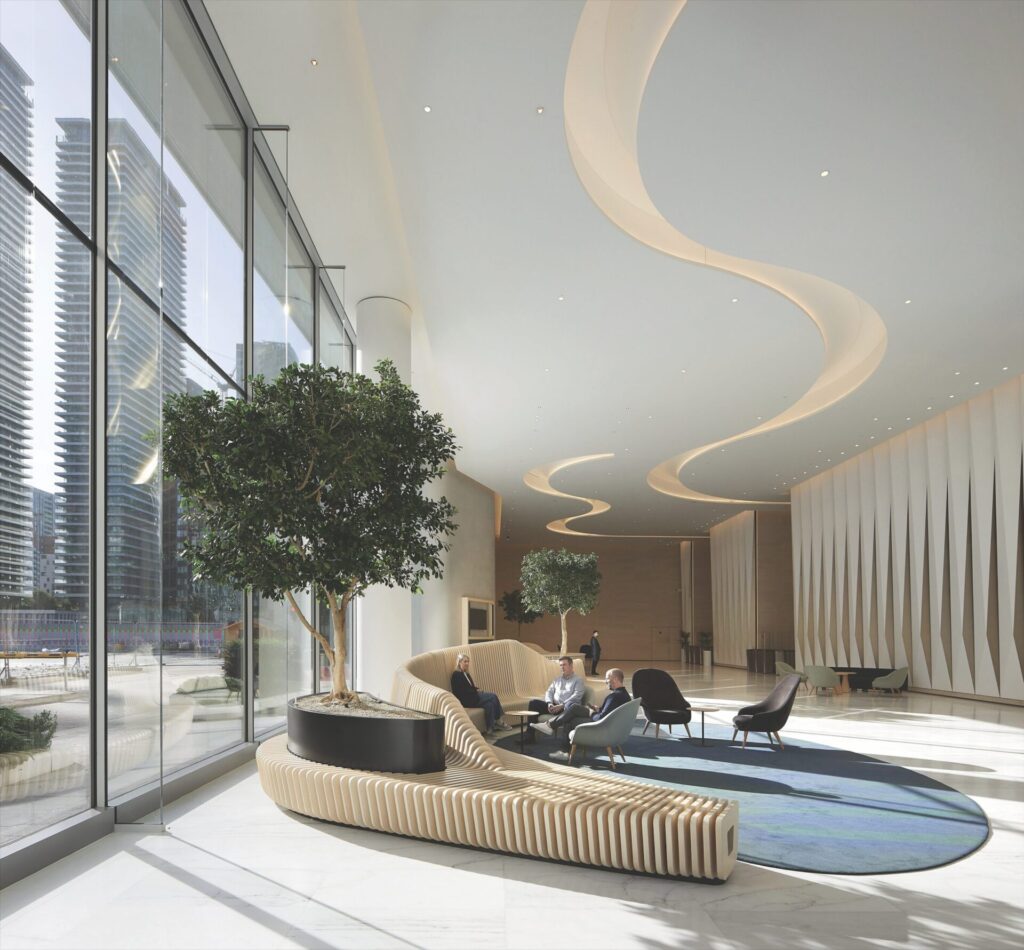
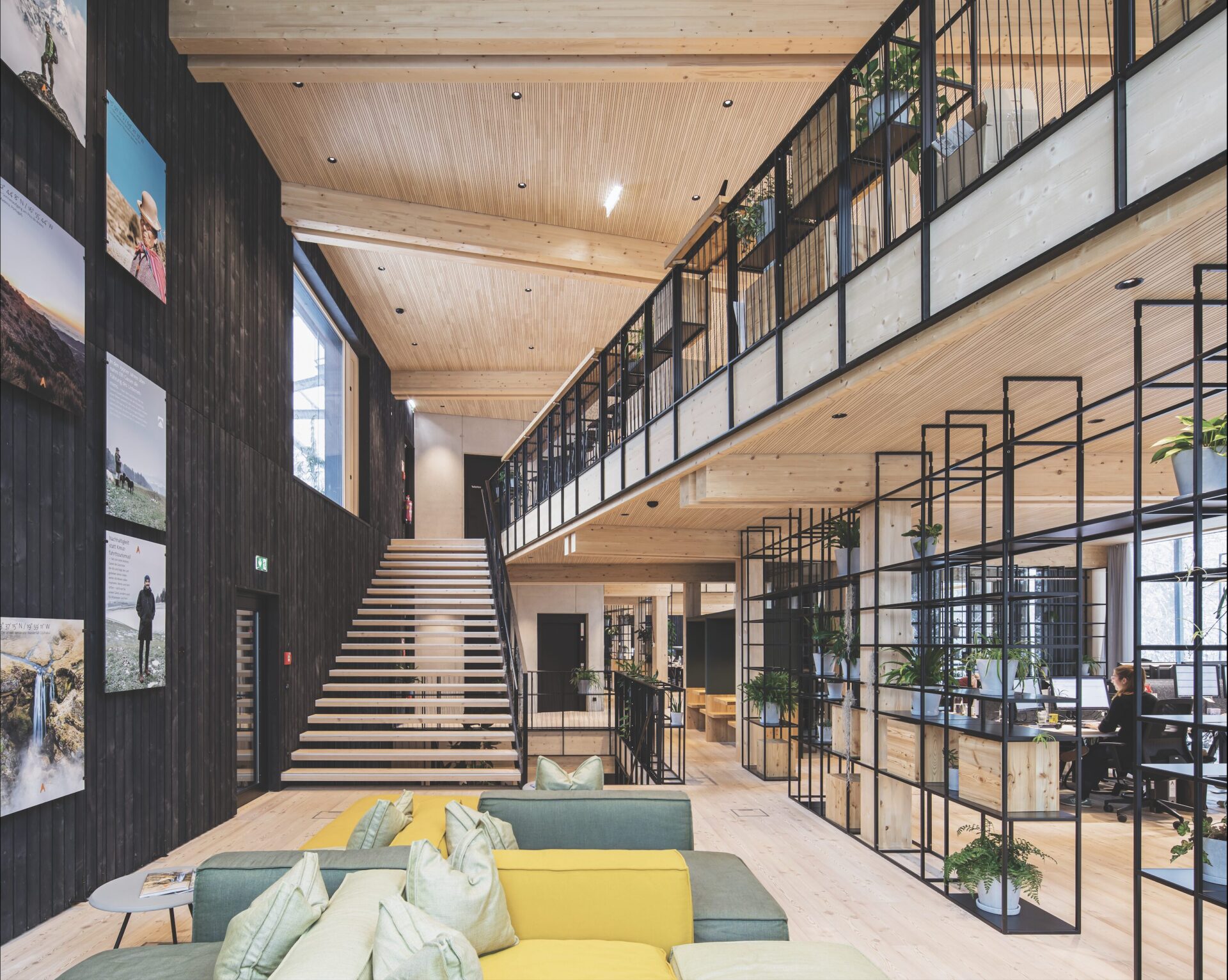
A verdant narrative is depicted as soon as one steps into EBRD’s new headquarters. As a ‘green bank’, the ethos is rooted within the design, using biophilic forms and materials that bring the natural world into the building, nourishing circular economy. The reception area, where bespoke design elements are seamlessly integrated into the base build architecture, draws you in at once. A new dedicated events reception desk, café and sculptural timber seating are brought together and complemented by soft furnishings to create an exceptional arrival sequence. The building’s facade points to a series of communal destination spaces, pointing guests and staff towards London and the River Thames, readily encouraging movement around the building. With over 300 trees and plants throughout the entire building, an immersive experience is heavily articulated. Much like a pathway through the natural world, the project seeks to connect occupants directly with nature, enhancing well-being. From raw, natural materials and patterns, to the geographical references of the sweeping curves that reflect The Thames, a myriad of details are employed across the board.
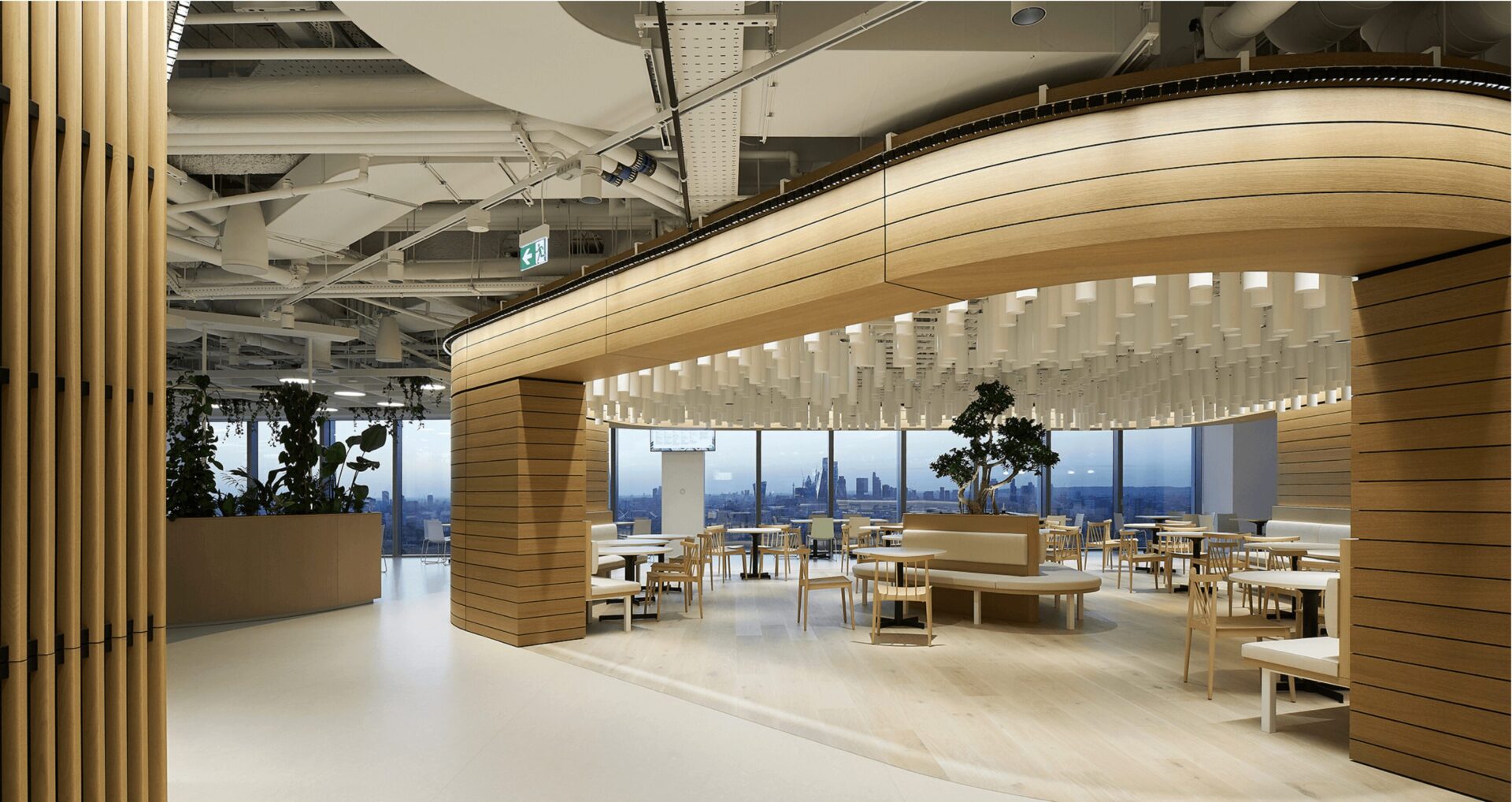
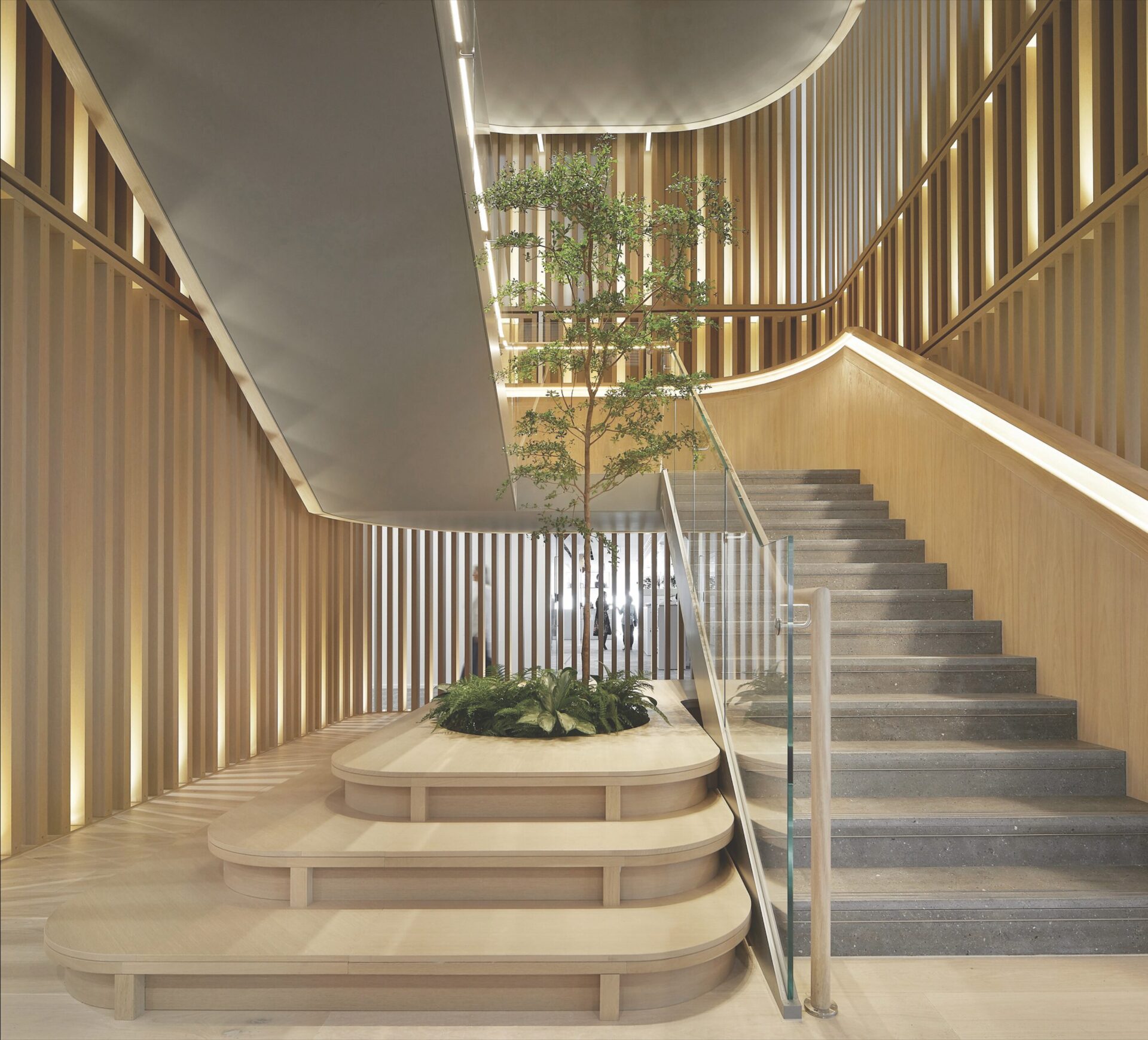
With a staircase lined by continuous timber panelling, curling around single, centrally placed trees, the workplace floors foster an interconnected network of innovative ideas. Even the signage and environmental graphics reflect organic shapes and the movement of water. The café and deli on level 16 have a variety of settings from booths to open areas divided by soft curtains, very much delivering the experience of ‘the garden at the top of the world’. The staff restaurant on level 24 is something you do not want to miss. Offering a separate café area, multiple seating options and configurations to accommodate different event types, a versatile experience is generated. The ‘cocoon’, a timber structure with tube and lighting features in the ceiling, including a central bonsai tree and a palette of light finishes, creates a calm, grounded energy. Products used in large areas were targeted for research, focussing on the most innovative with high recyclable content, good circularity and low VOCs. This project incorporated the single largest amount of linoleum installed in the UK, with the product specified for its natural raw materials and low toxin levels. Carpet manufacturer Tarkett upgraded two of their products to a Cradle to Cradle gold certification for the project, with a reduction of waste implemented through the use of standard sizes, modularity, and prefabrication.
With regeneration at the heart of the project, future adaptability was at the forefront of the design, alongside the idea of ‘designing for deconstruction’ aimed at pushing the boundaries and limiting the use of glues and adhesives. This then promoted mechanical fixings so that components could easily be disassembled and reconstructed, whilst also remaining accessible for all future maintenance requirements. Flawlessly cultivated, a key part of the final submission to the client as part of the Operations & Maintenance manuals was a full Circular Design Guide and a deconstruction guide, ensuring that future operations teams have the opportunity to adapt the design for long term requirements. Technology is also a core part of the impactful human-centred focus, one which conveys truly intelligent building technology. With a smart app, portal or kiosk, it seems as though everything has been considered. Sound masking is installed in all open plan areas with a centralised dashboard to log and adjust user’s feedback and requirements. Sustainable measures in the project include a vast array of impressive implementations.
Dubbed by BREEAM RFO 2014 as ‘Outstanding’, it is not surprising to see the long list of elements that are part of executing such a title. From having a WELL v² ‘Platinum’ Certification, minimised operational carbon, a lighting load with less than 5W/m², low VOC material, sustainable procurement, minimal plastic and packaging usage and more, it is clear that designing for deconstruction within contractor design packages, including the reuse of off-site furniture, is a profoundly successful approach and one that has set this project apart from the crowd. That is not to forget a visitor management solution, occupancy sensing with utilisation analytics and reporting, air quality sensing and reporting, an asset information model for building maintenance services, integration with a Facilities Management Helpdesk application for automated reporting, BMS reporting and fault alarm management, and a smart app that also provides push notifications to all staff. The project strikes a balance between human- centric and planet-conscious design, through the development of a bespoke sustainability charter based on five defined factors: the social network, the human interactions, the physical assets, the natural environment and the economic aspects. As a result, the project has minimised its environmental impact, but not at the expense of occupant well-being.
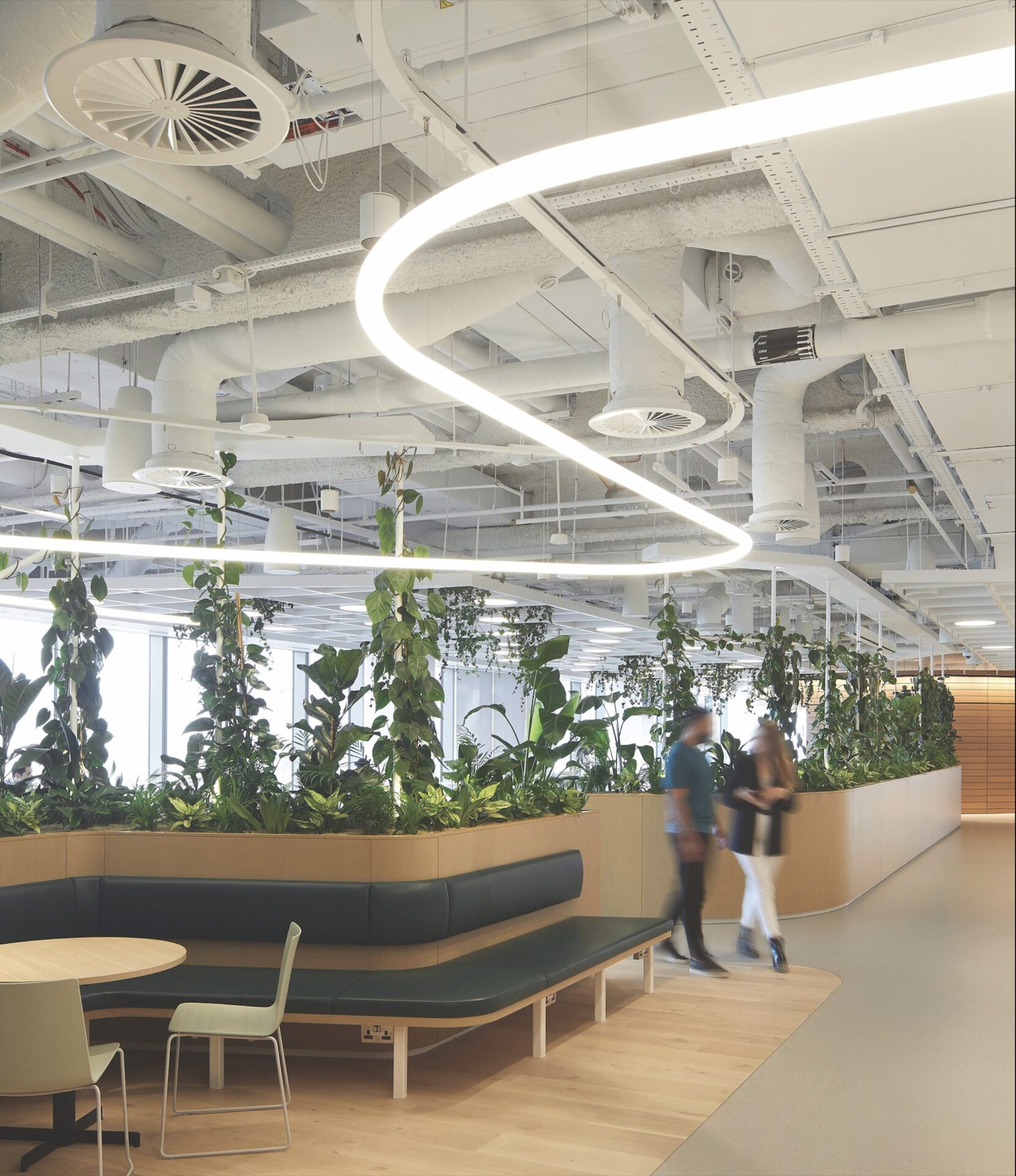
Human centred at its core, with daylight, healthy materials, indoor air quality and design enhancements, it seems that all elements of the work place are watered. Work-life balance has reached equilibrium, with different social activities from restorative spaces to a mother’s room’s and more, attending to a range of necessities. It doesn’t stop there, with hydration stations, catered meals and a truly curated existence reeling you in. That is, if you are not already enamoured.
LATEST ARTICLES
LATEST ISSUE